Strength plateaus don't always show up as "I can't squat heavier at the gym."
Maybe you've been doing clamshells religiously for months, hoping to feel stronger — but nothing's really changing.
Or you're doing all the "right exercises" and still feel stuck.
Or maybe a quiet voice has started to wonder: is this just what aging feels like?
Here's the thing almost no one tells women: it usually isn't age. It's strength.
Most of what we call age-related strength loss isn't aging — it's disuse. "Use it or lose it" isn't just a saying; it's most of the story.
But here's where a lot of women get stuck.
You're probably doing the right first step — and stopping there. Because no one told you there's a step 2, 3, and 4.
If you've been handed a sheet of clamshells, lateral band walks, and glute bridges, here's what you need to know.
They do a real job early on. They're fantastic introductory strength exercises — that's exactly why so many people start there.
But here's what nobody tells you: you can do clamshells faithfully for a year and never get any better at climbing stairs. And there are two reasons why.
First, your body only gets strong at the thing you actually train it to do. Clamshells happen lying down. Climbing stairs, getting off the floor, catching yourself when you stumble — all of that happens standing, on your feet, under your full bodyweight. Lying-down exercises don't carry over to standing life. Helpful at first? Absolutely. The long-term solution? Not quite.
Second, you can't make a clamshell hard enough once you pass a certain strength level. Strength only builds when your muscles are pushed with tough resistance — and then pushed a little harder over time. A band around your knees tops out fast. There's nowhere left to progress to (unless you're looping chain tires around your legs, but let's be honest, that sounds awful).
So you stay at the introductory level — working hard, staying consistent, and quietly wondering why the stairs still feel exactly the same.
What actually builds strength after clamshells
Real strength gets built in stages, and it has to move in a direction: from isolated and lying down, toward standing and loaded, and eventually toward movements that look a lot like your real life.
Here's what a science-backed progression can look like:
Month 1 — Banded clamshells
Month 2 — Bodyweight squats
Month 3 — Bodyweight step-ups
Month 4 — Bodyweight lunges
Month 5 — Weighted lunges
Month 6 — Getting up and down from the floor/max resistance step ups/lunges/etc
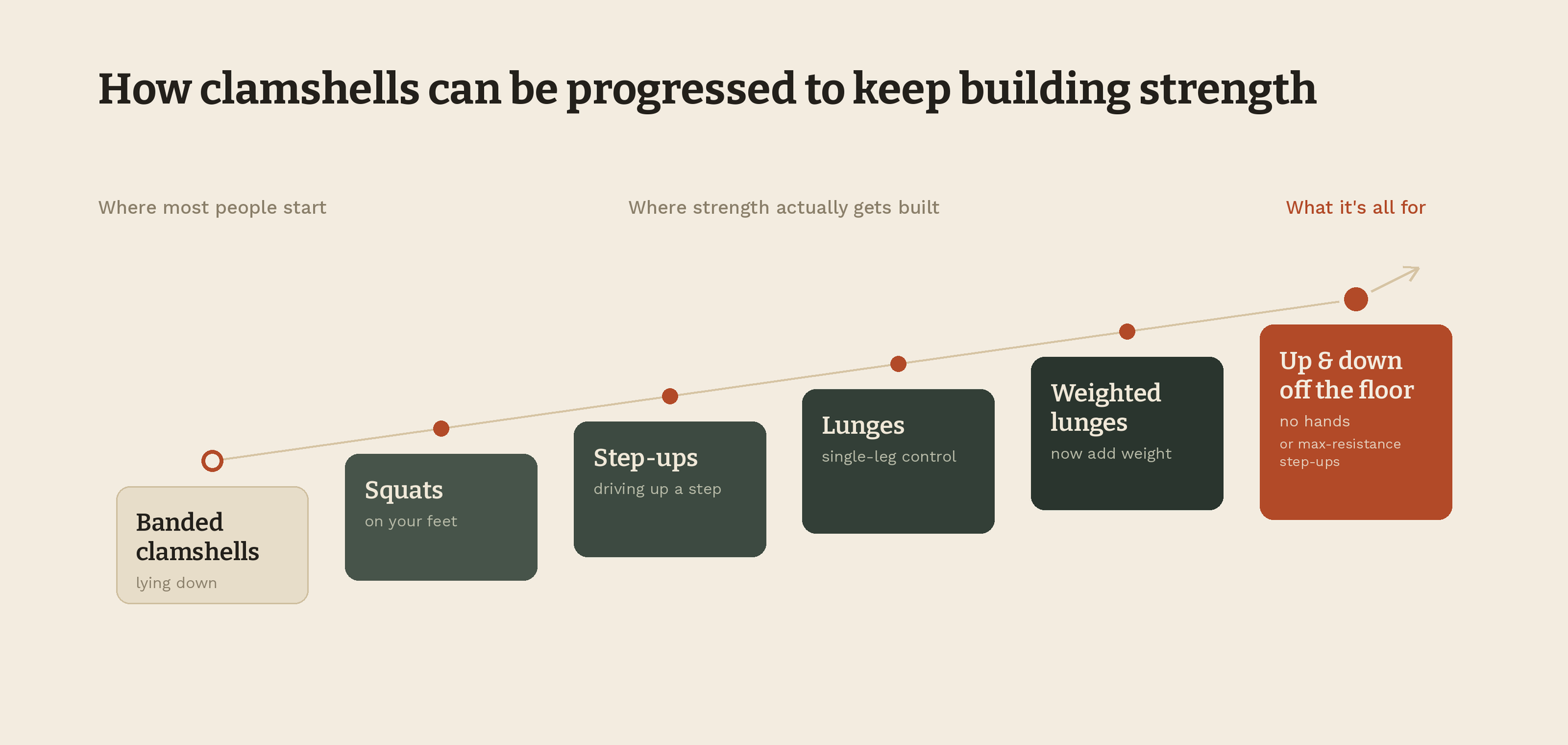
See how the challenge climbs every month?
That's the whole thing. Your body adapts to the demands you place on it — so doing the same exercises for a year will eventually plateau. That's fine if you're trying to maintain strength. But if you're trying to build strength, we have to keep making the work harder to break you through the plateau.
That progression is what turns "doing my exercises" into "actually getting stronger."
Getting stronger isn't about doing more exercises. It's about doing the right exercises and letting them get appropriately hard. For most women, that's fewer, more purposeful movements — not a longer list of easy ones.
One of my clients went from working out 5 days a week and not getting any stronger, to working out 3 days a week and lifting heavier than she ever has in her life. Not because she's doing more — she's doing less. But she's doing the movements that match her level, and progressing them over time. That's what makes the difference.
Now, here's what I can't do in a blog post: tell you exactly where you should start, which movements fit your body, how fast to progress, or what to adjust when your hip or knee flares up. That depends entirely on where you're starting from.
But for now, know this: if you've been doing your clamshells and wondering why the stairs haven't gotten any easier — you're not failing. You were just never shown the rest of the bridge.
More soon,
Chelsea